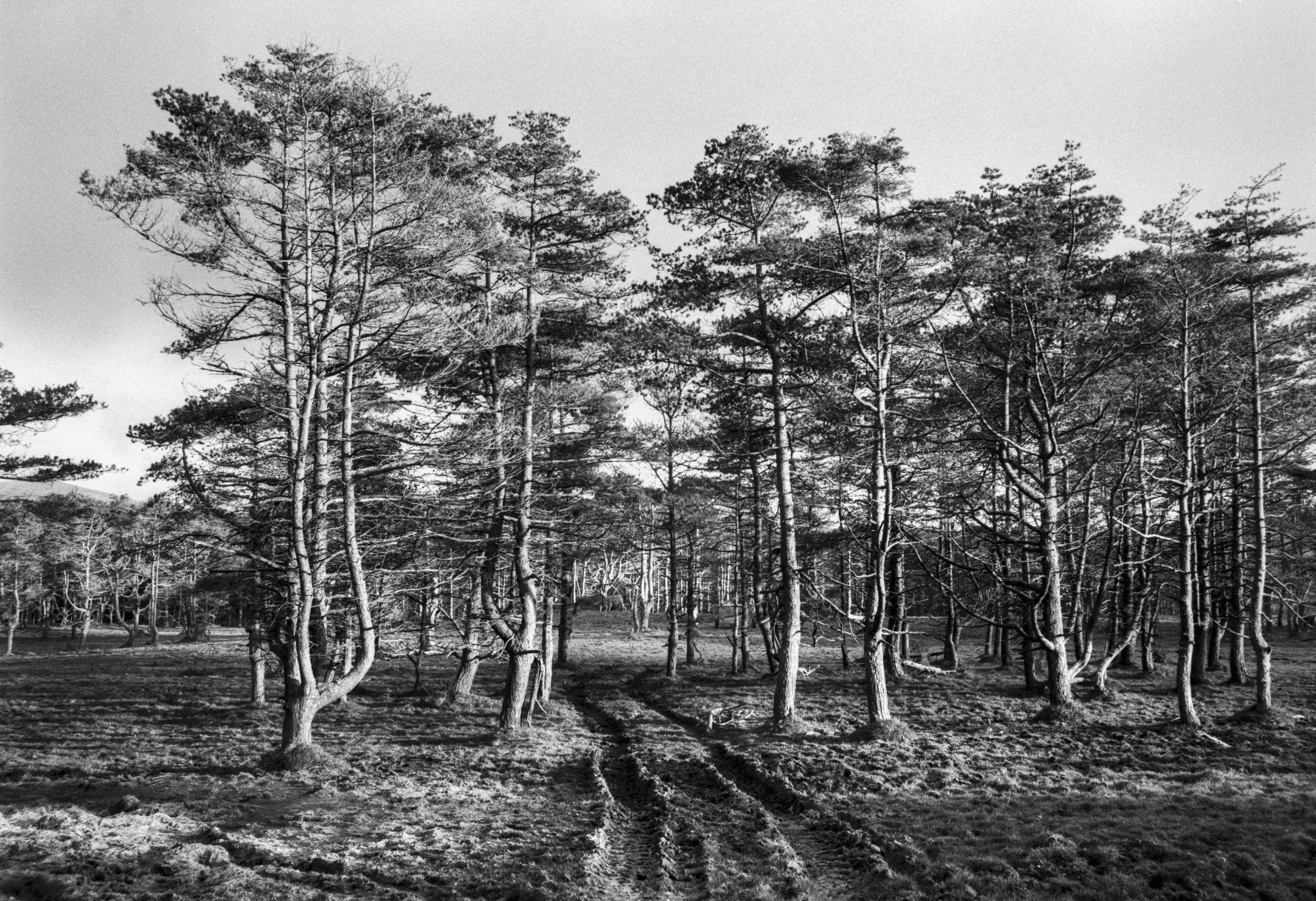
Galicia’s climate tends to be quite relentless. It has a reputation for being humid, rainy, windy, and generally unpleasant, at least when compared to the south of the Iberian Peninsula. But on those rare days when the sun comes out and the weather gives us a break, this land is so beautiful it almost hurts. All these climatic traits shape our landscape, and in certain places they leave a particularly distinct mark, such as in this small pine forest high up on “A Serra da Faladoira.”
Pines are nature’s sculptures. Few trees are as malleable or as prone to absorbing the harshness of their environment into their very structure, their branches, their trunk orientation, the arrangement of their needles. It’s no wonder they’re so iconic in the world of bonsai; they’re incredibly responsive to shaping. Galicia’s climate, like a bonsai master, applies all kinds of pressure and restriction, sculpting their best forms and giving them a unique personality.
Beyond capturing their twisted, weather-worn shapes, the day I took this photograph the sunlight happened to be at its golden hour, and it was hitting the scene horizontally, creating a wonderful interplay of light and shadow. Of course, a black-and-white photograph doesn’t show warm golden tones, and in theory, there should be no difference between warm and cool light in monochrome. But allow me to go against all logic: whether it’s the position of the sun, the intensity of the light, or simply a subjective feeling, the lighting in this photograph still conveys the warmth of sunset. Perhaps memory is distorting my perception, but I believe the golden hour always leaves a trace, even if it’s only visible through subtle nuances.
