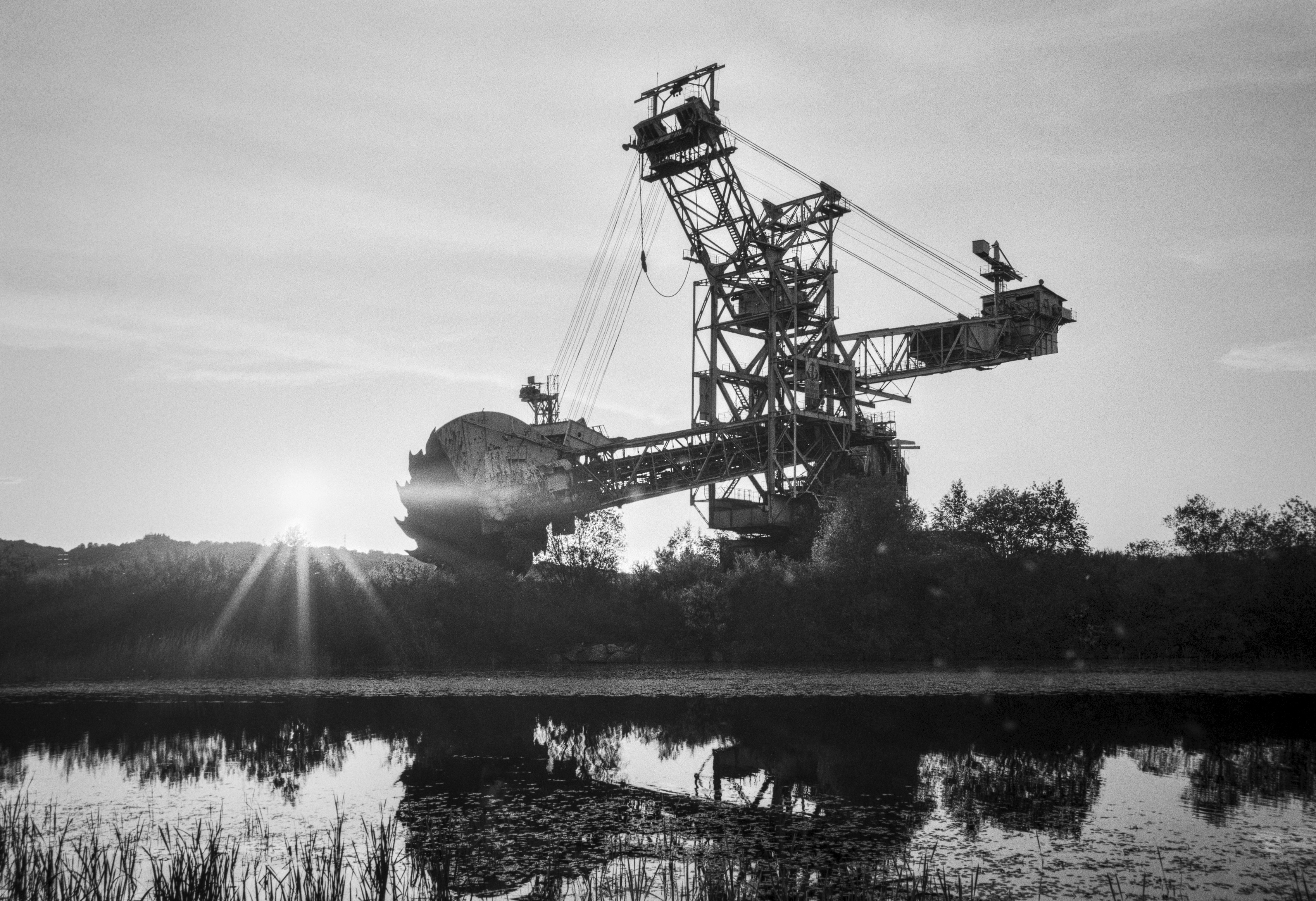
Although I like to switch themes with each new entry, today I’m going to stick with the industrial side of things a little longer. Anyone who’s passed through As Pontes de García Rodríguez in recent years will have come across this enormous titan. It’s a bucket-wheel excavator from the old lignite mine. At one time, there were as many as seven of them, though in the final stage of the mine’s operation only five remained in use.
Today, we’re so used to all kinds of visual stimuli that a structure of this size and complexity might not seem all that surprising, but I can assure you, the first time I saw one as a child, I was absolutely blown away. Traveling to As Pontes felt like entering an alternate universe. In the distance, you’d be greeted by a towering chimney that grew taller and taller the closer you got. It felt like you’d never reach its base. Then came the factory complex, which rivaled the hypnotic visuals of Blade Runner. And just when you thought you’d seen it all, the bucket-wheel excavators would appear, constantly in motion, eating away at the earth like giant coal-devouring hippos. Wherever you looked, there was something to marvel at.
That single remaining machine now stands as a powerful reminder of an entire era. It’s located in a prime spot beside the artificial lake that occupies the former mining site, an immense body of water five kilometers long, two wide, and up to 200 meters deep. I remember visiting the mine on a school trip back in sixth grade. We rode a bus all the way down to the bottom. Thinking that this vast space, once teeming with bucket-wheel excavators, conveyor belts, and heavy machinery, is now completely submerged still feels surreal. Some changes unfold subtly, almost without notice, but in As Pontes, transformation has taken place on a monumental scale.
