I think many of us, when we were children, at some point during our childhood ended up enjoying the packaging of a toy more than the toy itself, turning it into an impregnable castle, a top secret garage, or perhaps a spaceship. Maybe, at another time, we came to value the tin box of a biscuit tin, where we kept newspaper clippings, important bills, or perhaps photographs from our teenage years that were better kept private, more than the biscuits themselves. And I am sure there are many more examples like these, in which the content becomes something anecdotal compared to the container, which ultimately turns into the true protagonist of the story.
The truth is that this is not exactly the case I want to share with this photograph, because the content, nothing less than an exhibition by the Magnum Agency, was absolutely outstanding. But I have to admit that the real surprise came from the setting itself: La Vega Arms Factory, a place I had never heard of and which left me completely captivated by its architecture and its decaying charm.
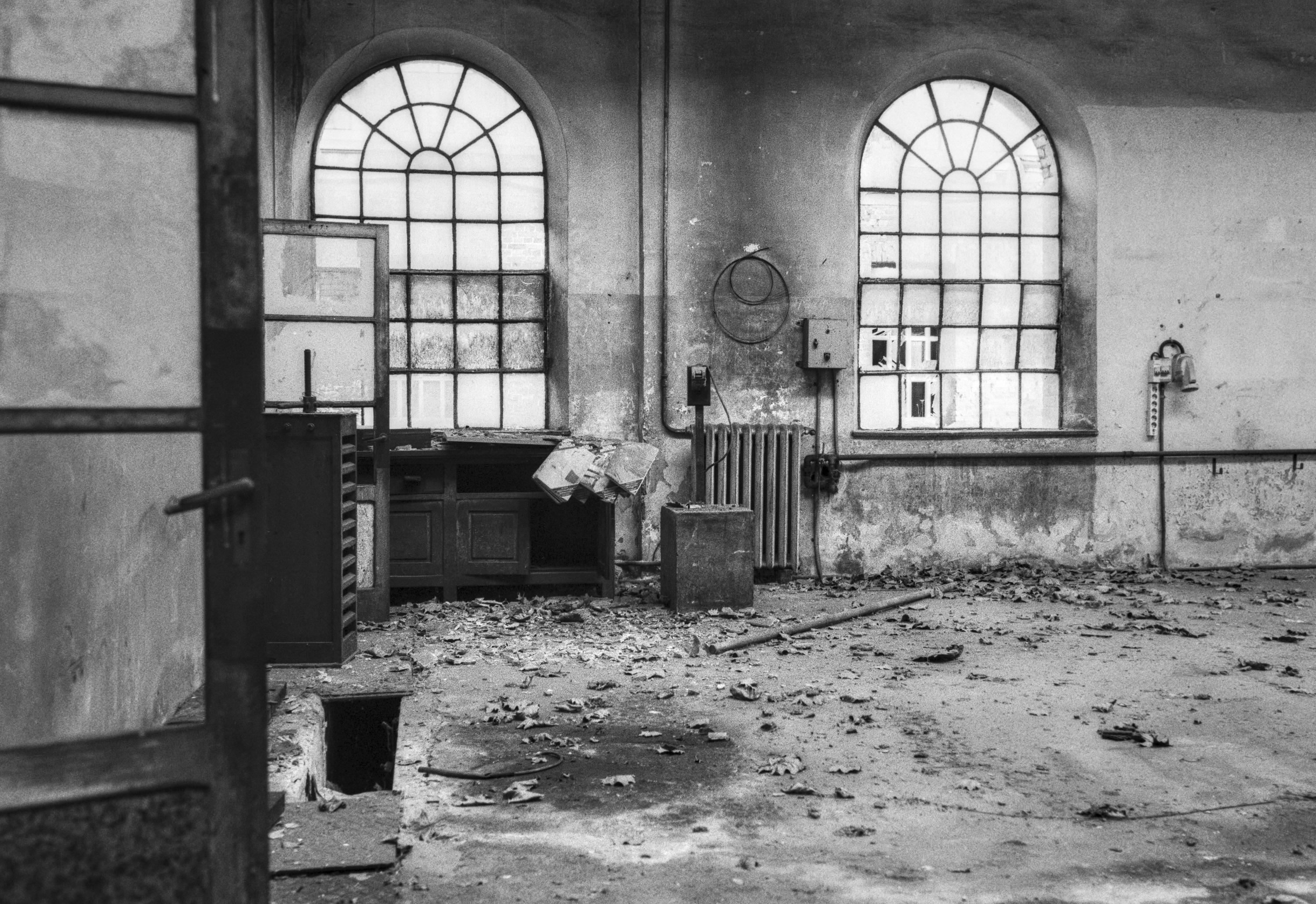
Although most of the rooms I visited had been adapted to host different exhibitions, and part of their architectural and historical value was hidden behind the layers of information displayed during those days, wandering through the different areas of the factory I was able to “peek”, through a few dark and dusty windows, into certain abandoned spaces that still preserved part of the historical legacy that fascinated me so much.
More specifically, the photograph I am sharing today appears to depict one of the many workspaces that once existed inside this factory, where some remnants of furniture and even a few documents or brochures from its final days of operation can still be found. The decay of the room, together with its large wrought iron windows with rounded arches, so characteristic of the industrial era, gives the whole place a very distinctive aesthetic that is difficult to find today with such a degree of authenticity.
In a way, it is sad to see the room in such a state of abandonment, but on the other hand, had it been repurposed for exhibitions or any other cultural use, it would probably no longer retain that authenticity or those small traces of the past. And with that, part of its historical value would also have been lost. I only hope they take care of the structure of the building and, if necessary, carry out the maintenance it requires while always respecting its essence and value. The entire factory complex is a true gem, and I am very glad that it has been opened to the public through this kind of cultural activity. I hope it can serve as an example for many other similar places.
