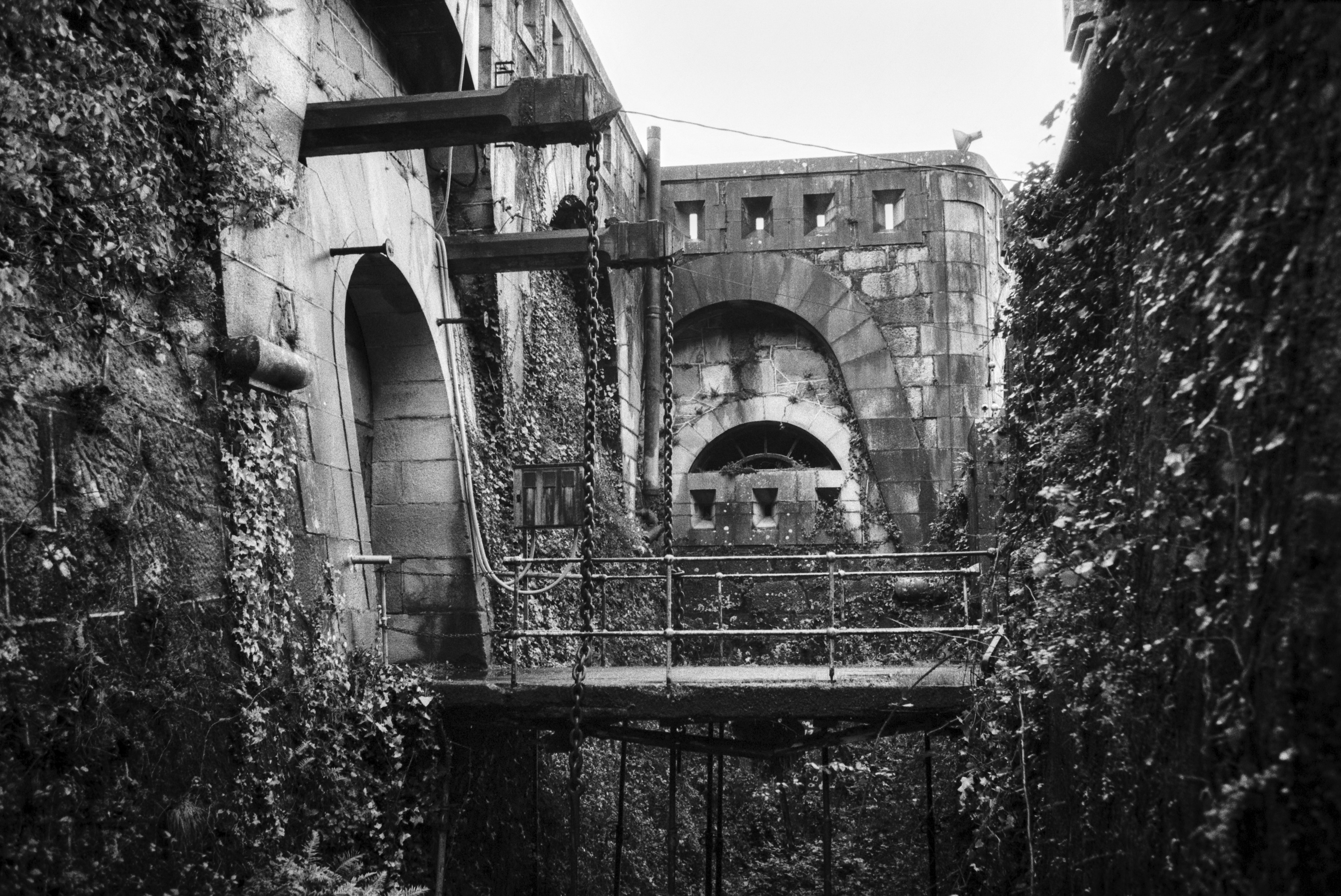
Black and white photography works in a very different way from colour photography. By reducing an image to a scale of greys, bounded by the purest white and the deepest black, many photographs lose part of their impact. Once colour disappears, some scenes become a uniform mass of similar tones, lacking the contrast and visual elements needed to draw the viewer’s eye. That is why those of us who enjoy black and white photography tend to seek out strong contrasts, rich textures, and clearly defined silhouettes, elements that allow us to create images with character and visual strength without relying on colour to capture the viewer’s attention.
For that very reason, old buildings, with their peeling paint or the textures that mould, moisture, and the passage of time leave on stone, are ideal subjects for this kind of photography. In these cases, the appeal of the image lies less in the classical beauty of clean, symmetrical forms than in the contrasts and textures that years of decay gradually carve into its surfaces. It is a different kind of beauty, one that depends far more on the viewer’s interpretation than on traditional aesthetic standards.
Sometimes, however, something even more interesting happens. When a building was originally designed with a clear sense of aesthetic refinement, but years of abandonment have left their mark on it, these two forms of beauty come together and coexist in a remarkably balanced way. That is the case with Castillo de la Palma, located on the Ferrol estuary opposite the town of Mugardos. The fortress is imposing, robust, and functional, yet at the same time its elegant proportions and carefully considered architecture are impossible to overlook. It also stands in an area of outstanding natural beauty that gives it a remarkable sense of seclusion and intimacy.
All of this, together with the deterioration it has suffered over recent years following the failed sale of the property to a private company, has made it a perfect setting for the kind of photography I enjoy most. I sincerely hope that one day it receives the care it deserves and is properly restored, but I cannot deny that its abandoned state has given me photographic opportunities I would have struggled to find elsewhere. Black and white photography, after all, sometimes has rather peculiar tastes.
